Crack-to-Bang: Ranging, Not Localization
Crack-to-bang (also called crack-thump) is a published forensic-audio technique that is routinely over-read — including by people citing it to claim a precise shooter location. This page explains exactly what it establishes (a distance), why a distance is not a location, and where its assumptions inject error. The worked example is the publicly released correspondence between independent researcher Matt Kester and Dr. Robert Maher (Montana State University, author of Principles of Forensic Audio Analysis) about the shooting of Charlie Kirk at UVU.
SUMMARY
- ▸ Crack-to-bang measures the time gap between the supersonic shock (the crack) and the muzzle blast (the bang) at a single microphone, and converts it to a distance.
- ▸ A single distance places the source on a circle around the microphone — it gives range, not direction. Pinning a shooter needs an independent bearing or multiple synchronized sensors.
- ▸ It must assume the bullet's velocity and on-axis geometry; both inject unquantified error, especially in reflection-heavy environments.
- ▸ In the Kirk case, Dr. Maher — a leading expert — reached only "consistent with ~140 m" from one usable recording with a rough measurement and an assumed bullet speed. That is the method's honest ceiling.
- ▸ A single crack-to-bang measurement establishes, at most, how far — never where a shooter was. As courtroom localization it is not Daubert-ready.
1 // What Crack-to-Bang Measures
A supersonic rifle bullet produces two separate sounds. First, the ballistic shock wave ("crack") — a cone trailing the bullet, like a miniature sonic boom. Second, the muzzle blast ("bang") — the explosion at the firearm, radiating from a fixed point. At a microphone, the crack arrives first and the bang second; the gap between them grows with distance.
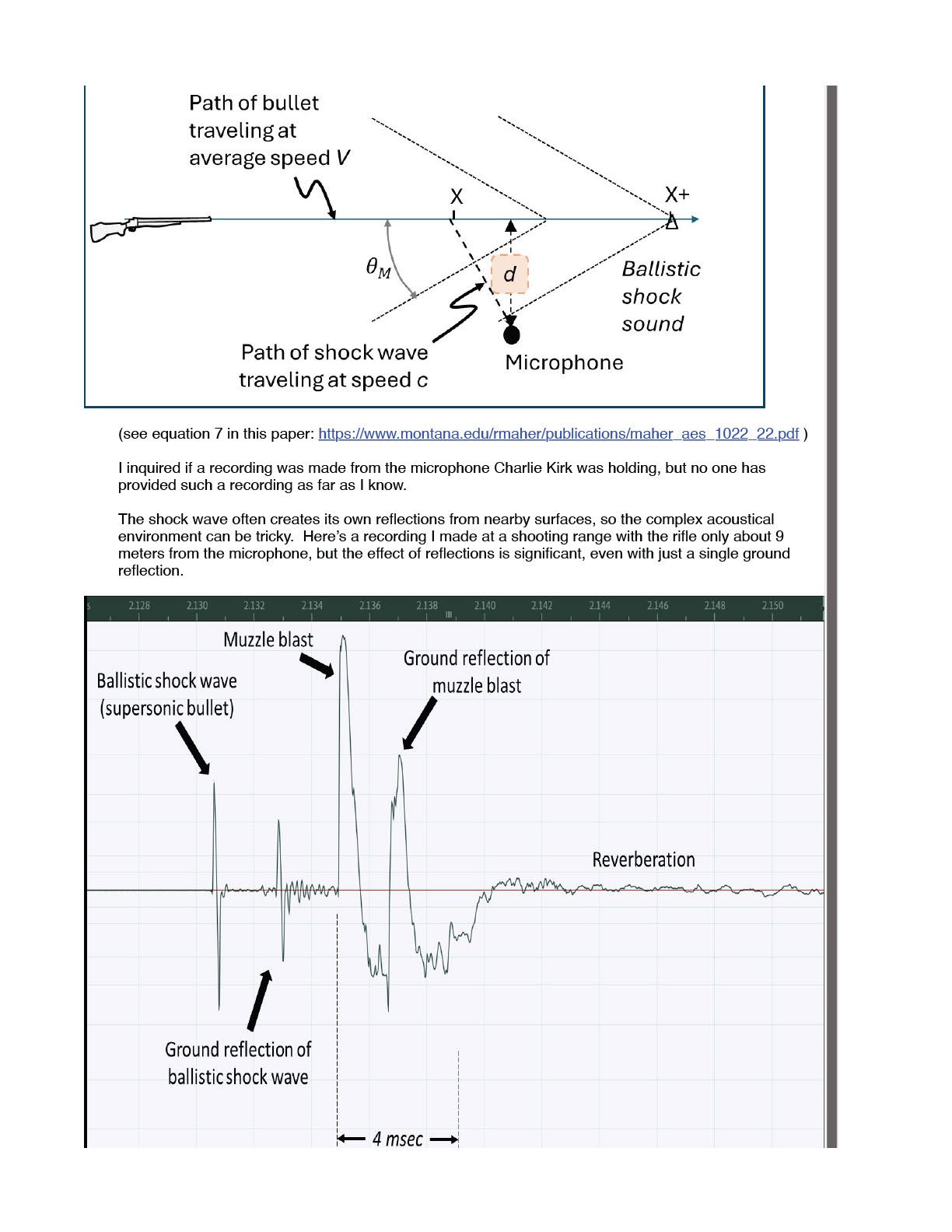
For a microphone roughly on the bullet's line of flight, the gap relates to distance by a simple expression Dr. Maher states directly in his email:
distance = t_gap / ( (1/c) - (1/V) )

   t_gap = crack-to-bang time gap (s)
   c     = speed of sound  (~343 m/s)
   V     = bullet speed    (must be ASSUMED)
That is the whole engine. Feed it a measured gap, an assumed bullet speed, and a speed of sound, and it returns one number: a distance. Everything else — whether that distance means anything, and whether it can locate a shooter — follows from the geometry below.
2 // A Range Is a Circle, Not a Location
This is the crux. The formula returns a distance, call it D — the straight-line distance from the microphone to the firearm. A distance with no direction does not specify a point. It specifies every point that far away: the source lies somewhere on a sphere of radius D centered on the microphone (a circle, if you assume a ground plane).
One microphone, one crack-to-bang gap → one distance → a ~140 m circle drawn around that microphone. The shooter could be anywhere on that ring. Crack-to-bang, by itself, cannot tell you which way the shot came from — only how far.
To collapse that circle to a point you need information the single measurement does not contain:
- ▸An independent bearing (direction of arrival) — e.g. a directional/array sensor, or visual evidence of the muzzle flash/smoke.
- ▸A position established by other evidence and imported from outside the acoustics (e.g. a rooftop reported by authorities — a claim, not an acoustic measurement).
- ▸Multiple synchronized receivers — which is a different method entirely (TDOA), and the one this site uses.
This is exactly what Maher does: his acoustics give a range (~140 m) and no direction at all. The only bearing in play is the authorities' separately-reported rooftop east of the podium, which his range is then compared against — he notes the two "generally match." That is a consistency check against a claimed location, not an independent localization, and he is careful to frame it that way. No direction was ever recovered from the sound.
3 // The Off-Axis Problem
The clean formula assumes the microphone sits on the bullet's line of flight. Real cameras don't — they're scattered around the crowd, off to the side of the trajectory. Off-axis, the gap no longer depends on a single distance; it depends on where the mic sits relative to the bullet's path — its perpendicular miss distance and its position along the track — through the Mach-cone geometry (θM in Maher's diagram above).
Maher flags this himself, precisely:
"It is necessary to account for the location of the microphone not being on-axis with the bullet trajectory. If the bullet passes some distance from the microphone, the time gap would be shorter than predicted by the microphone being on-axis. I did not get precise geolocation of each recording device…"
The consequence is concrete and directional: for a given source distance an off-axis mic always yields a shorter gap (Maher's point above), so the on-axis formula reads that shorter gap as a nearer source — it underestimates the distance. The bias can't be corrected without the mic's position relative to the trajectory, which Maher didn't have. Combined with the reflection problem below (which pushes the other way), the "circle" from Section 2 is not just undirected but uncertain in radius.
4 // The Assumption Stack
Even setting the circle aside, the single distance number rests on a stack of assumptions, each carrying error:
Assumed bullet velocity (the big one)
V appears directly in the formula, and the round's identity/load is unknown, so it must be guessed. Maher assumed an average ~800 m/s (a round decelerating from ~838 to ~762 m/s). Hold the 0.241 s gap fixed and vary that guess: V = 700 m/s → 162 m; 800 m/s → 145 m; 900 m/s → 134 m. A ±100 m/s guess swings the range by roughly ±14 m — before any other error.
Speed of sound / temperature
Maher used c = 343 m/s (20°C) and notes the day was warmer, which raises c and pushes the estimate "slightly farther." This one is small and correctable if temperature is known — but it's another knob, not a measurement.
Reading the gap out of the echoes
The gap is hand-measured by picking the crack and the bang in a real recording full of reflections. Maher is blunt that this is hard: the longer video's audio is "dominated by acoustic reflections… I cannot easily distinguish which impulsive sounds are direct sounds and which are echoes." His own 9 m range test (Section 1) shows the crack, its ground reflection, the blast, its reflection, and reverberation all overlapping.
A single recording
The usable estimate came from one near-podium video. One measurement has no redundancy, no cross-check, and no way to compute an error bar. There is no confidence interval on "~140 m."
5 // Case Study — Dr. Maher's Analysis
To be clear up front: Dr. Maher's work here is competent and honest. He is a credentialed forensic-audio authority, his email is careful, and — crucially — he never claims more than the method can deliver. Reading it closely is the best possible illustration of crack-to-bang's true ceiling, because a leading expert applying it correctly still lands on a heavily-qualified "consistent with."
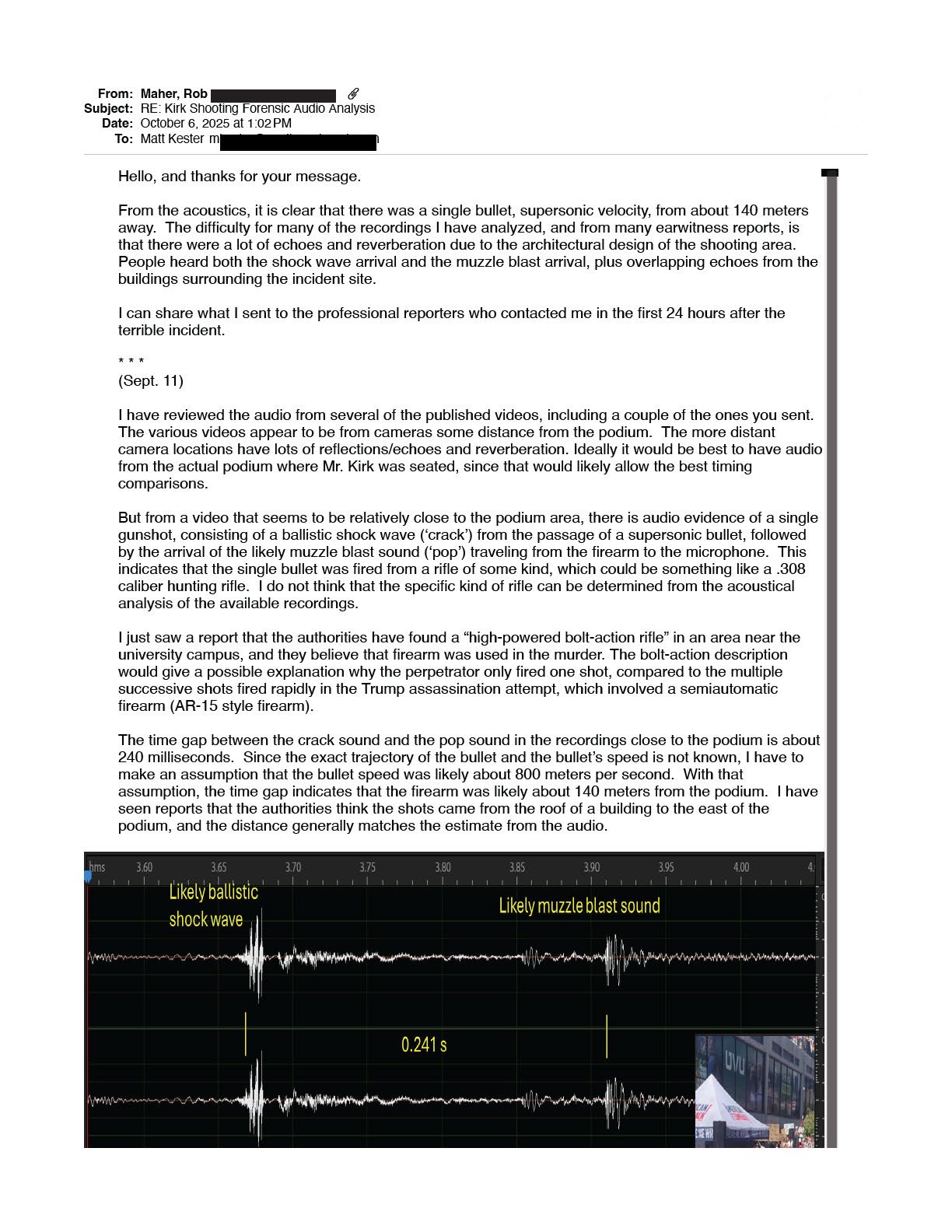
What he actually said, piece by piece:
- ▸Headline: "a single bullet, supersonic velocity, from about 140 meters away." Note that is a range, not a position.
- ▸Measurement: a ~240 ms (0.241 s) crack-to-bang gap on the one video "relatively close to the podium."
- ▸Calculation: 0.241 / ((1/343) − (1/800)) = 144.7 m, with the bullet speed assumed at ~800 m/s "since the exact trajectory of the bullet and the bullet's speed is not known."
- ▸Classification, not ID: consistent with a rifle such as a .308; "I do not think that the specific kind of rifle can be determined from the acoustical analysis."
- ▸No direction was recovered: the acoustics produced a distance only. Maher simply noted his ~140 m "generally matches" / "seems consistent" with the rooftop the authorities had already reported — a check against a claimed location, not a bearing derived from the sound.
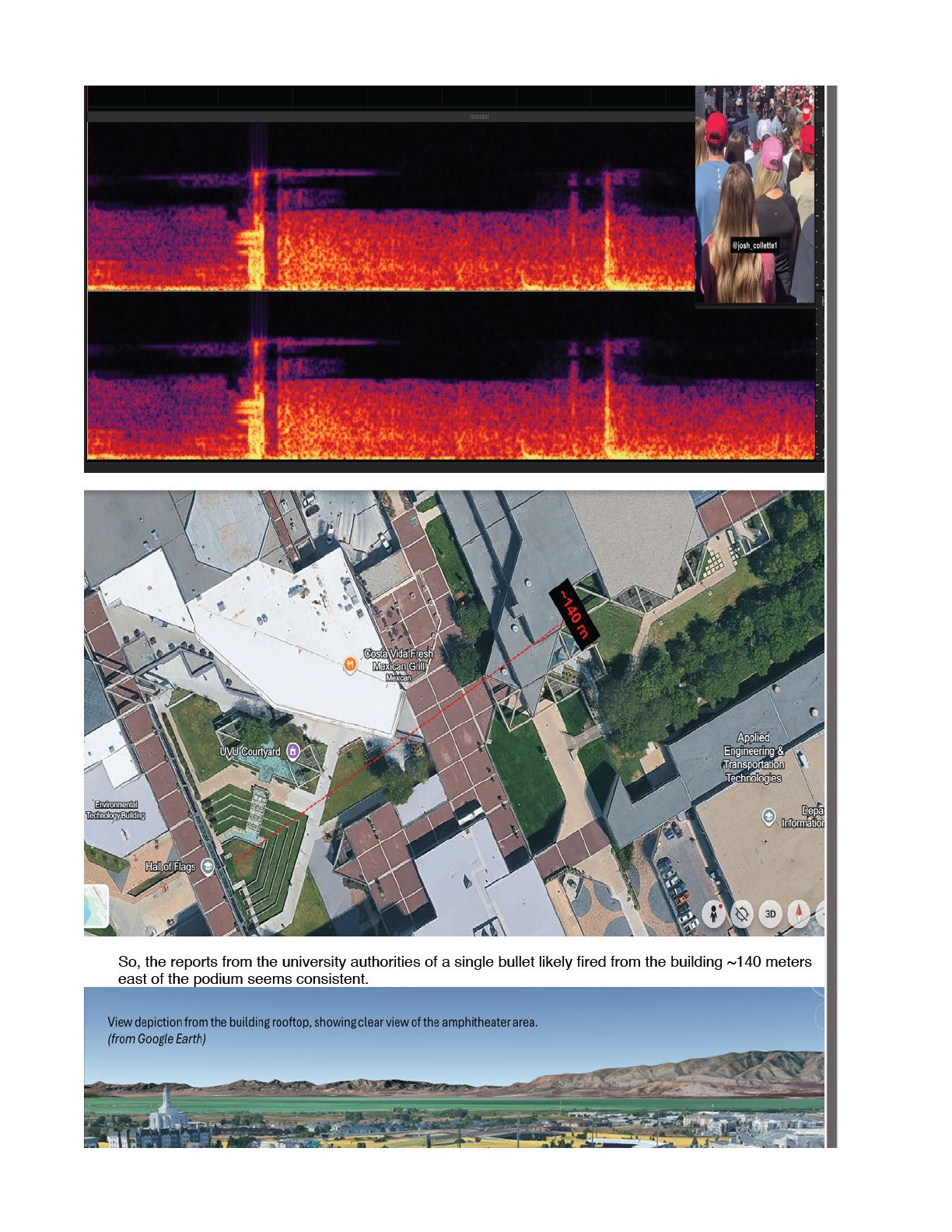
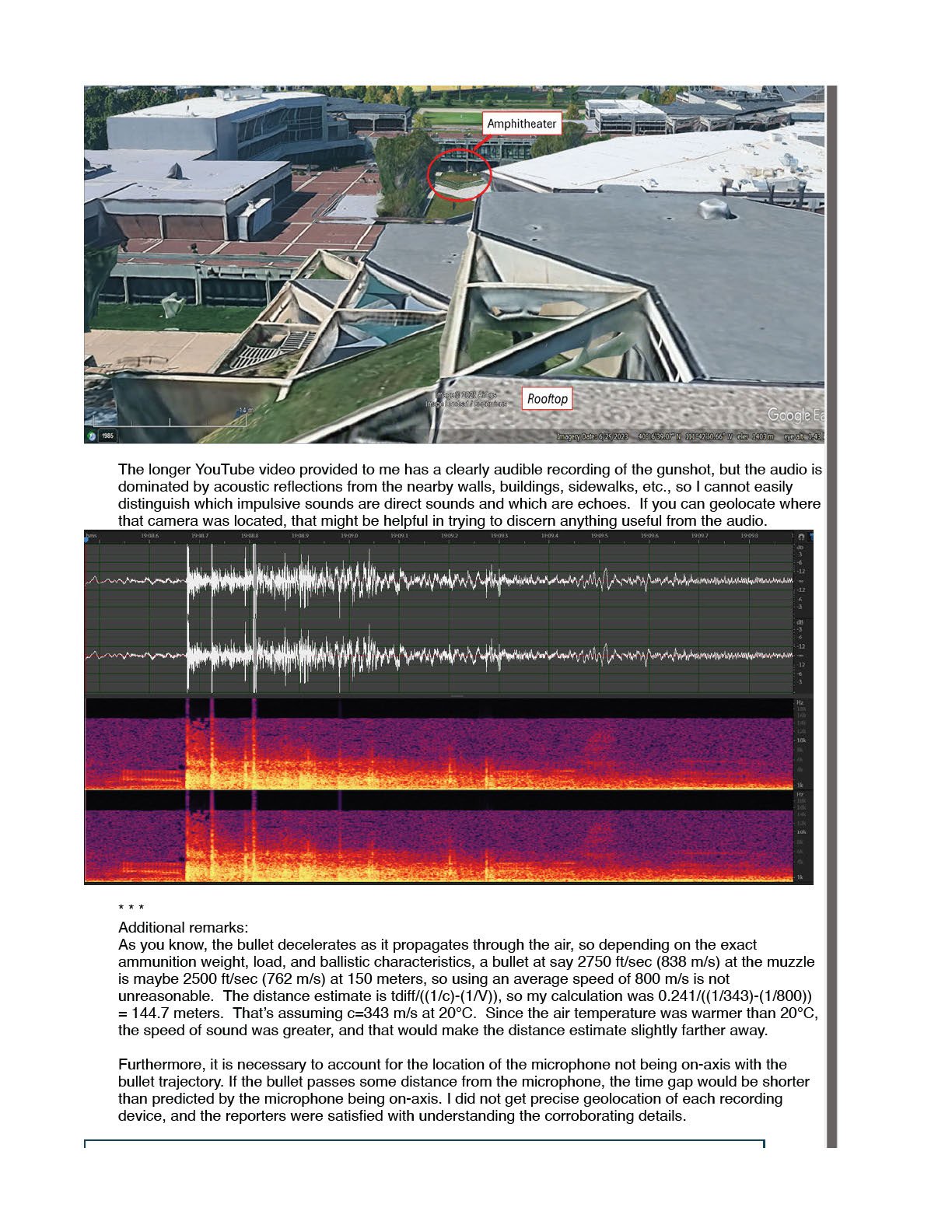
IS THAT THE DIRECT MUZZLE BLAST — OR AN ECHO OF IT?
The whole measurement assumes the second impulse is the direct muzzle blast. But these spectrograms are zoomed out, and the muzzle blast is a loud, low-frequency, omnidirectional event — in a courtyard ringed by buildings it returns as a dense cluster of reflections and a long reverberant tail, not one clean arrival. (The crack, by contrast, is a brief high-frequency N-wave whose echoes fade fast, so a strong impulse a couple hundred milliseconds out is far more likely a reflection of the blast than of the crack.)
That's the trap: pick a blast reflection instead of the direct-blast onset and the measured gap is inflated by the reflection's extra round-trip path — so the range comes out too far. Isolating the true onset means zooming into the waveform and testing whether candidate peaks line up with the extra path length to known surfaces — not eyeballing a wide spectrogram. That scrutiny isn't shown. Maher's own 9 m range test (Section 1) is the warning: even at close range the muzzle blast is immediately shadowed by its ground reflection. Here, separating the direct blast from its echoes was never verified.
And the tell on purpose: Maher wrote that he shared this with "the professional reporters who contacted me in the first 24 hours," and that "the reporters were satisfied with understanding the corroborating details." This was journalistic corroboration in the first day — explicitly not a forensic report offered as proof of a location.
6 // How It Was Used — Kester's Release
Independent researcher Matt Kester published this exchange. His goal, stated in his own Oct 2 message, was to fact-check the official narrative — he ran a 30-06 field test at a known 425 ft in Arizona, and used ChatGPT to help with the math (noting he was a Political Science major). He attached a "Bullet-to-Report Delay" table screening scenarios against the recordings.
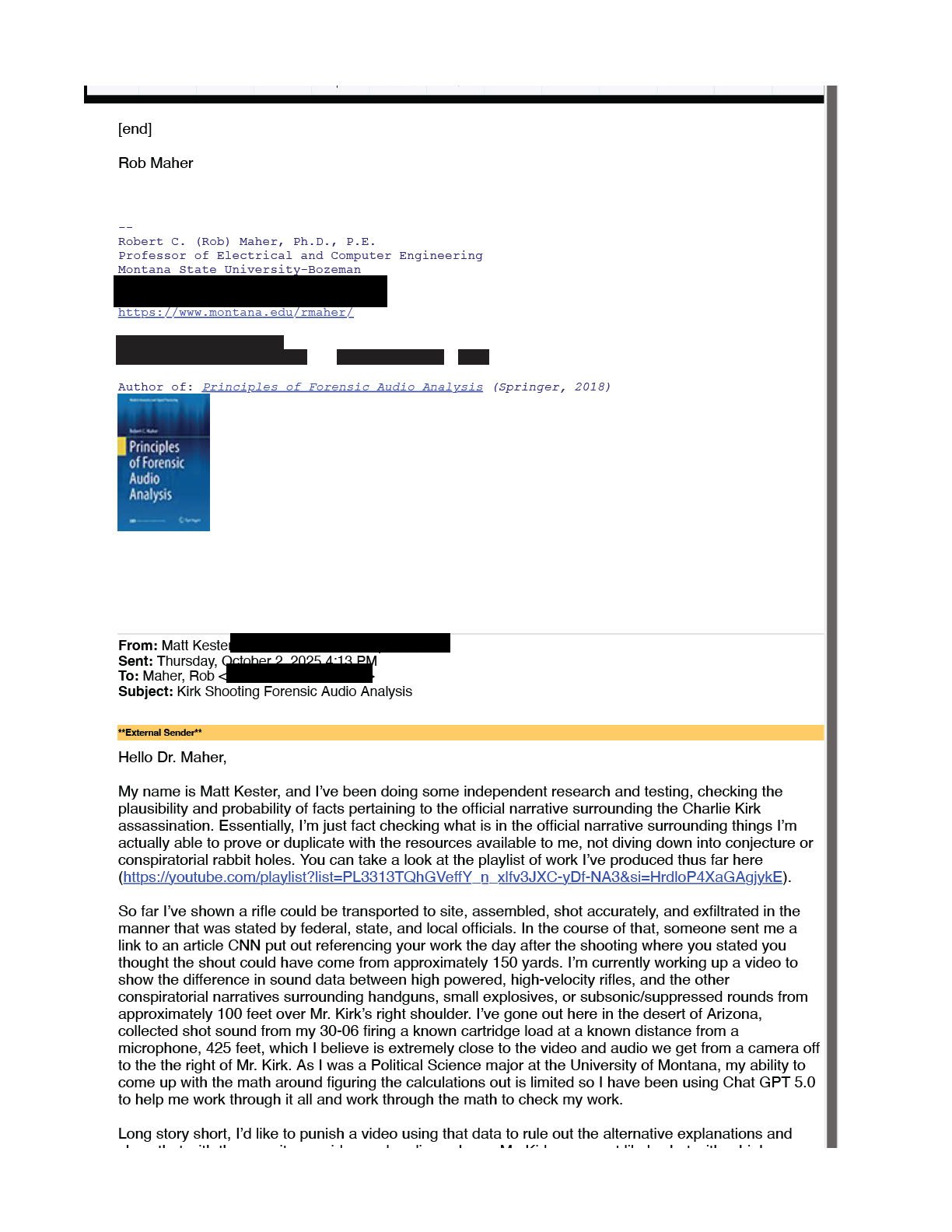
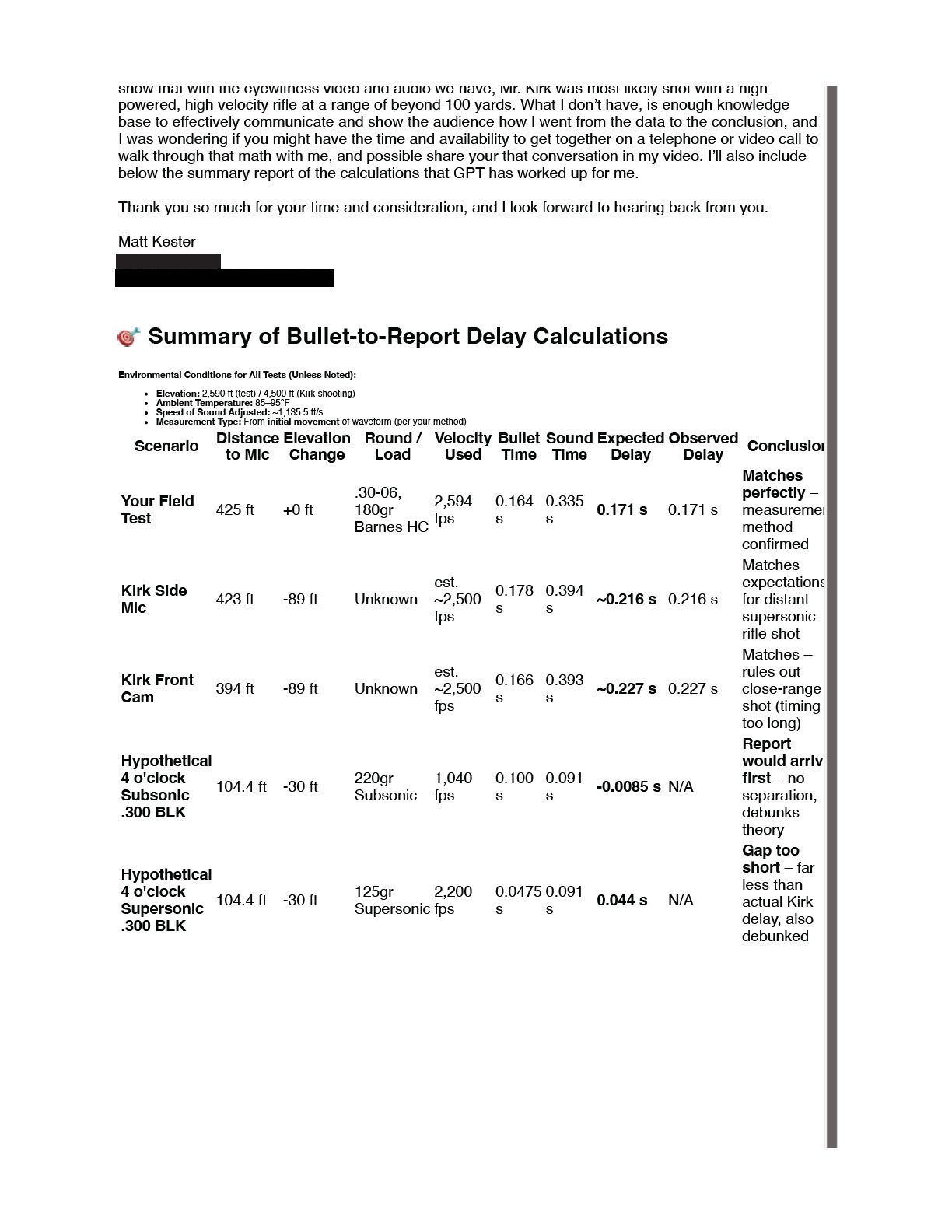
Read honestly, the table can argue against a few specific alternatives but cannot locate anything:
- ▸Its only use is narrow, exclusionary, and conditional: if the ~0.216–0.227 s gaps are genuine direct-arrival measurements, they are too long for a close-range or subsonic shot (a subsonic .300 BLK at ~100 ft would produce no usable crack-bang separation, or the wrong sign), so the table could argue against those theories. But that "if" carries the whole claim: the audio is dominated by reflections and reverberation, and there is no onset validation that the gap was read between the direct crack and direct blast rather than an echo (see Section 4). A misidentified arrival makes the gap too long or too short — which would undercut even this exclusionary use. It also says nothing about direction or position, and rides entirely on the assumed velocities below.
- ✗It cannot localize: "Distance to Mic" is an input column (assumed/known) and "Velocity Used" is assumed, so the table only confirms that an assumed geometry is consistent with the observed gap — it does not solve for where the shooter was. It also leans on AI-generated arithmetic, inheriting every error in Section 4.
7 // Could It Be Used in Court?
Plain-language explanation of evidentiary standards, not legal advice.
The method clears the "is it science" bar
Crack-to-bang ranging is published and peer-reviewed — Maher cites his own AES paper (equation 7) and authored a Springer textbook on forensic audio. So under both Frye ("general acceptance in the relevant community") and the first prongs of Daubert (testable, peer-reviewed, known principles), the technique passes the threshold "is this science" question. That is the floor, not the ceiling — and it says nothing about whether a given crack-to-bang opinion is reliable, which is the decisive question next.
But admissibility is about the method as applied
Federal Rule 702 requires the opinion to rest on sufficient facts/data and a reliable method reliably applied, with a defensible error rate. This specific application — one rough gap, an assumed velocity, no device geolocation, reflection-dominated audio, and no stated uncertainty — is exactly where a Daubert challenge bites. A "~140 m, consistent with the rooftop" corroboration is defensible; a claim that the acoustics prove a specific shooter position would not survive.
Honest verdict: not a robust, courtroom-ready localization — it cannot establish where a shooter was. At most it is a credentialed expert's preliminary consistency check on a distance, and Maher framed it exactly that way himself.
8 // What It Can and Can't Do
CAN
…and only if the direct crack and direct blast were correctly identified (see Section 5):
- ✓Estimate a distance/range to the firing point (under assumed velocity + on-axis geometry)
- ✓Confirm a supersonic projectile vs subsonic/suppressed
- ✓Corroborate a position established by other evidence (by supplying a range to check it against)
CAN'T
- ✗Give a direction — one gap is a circle, not a point
- ✗Confirm the second peak is the direct muzzle blast, not an echo of it off a nearby surface
- ✗Locate a shooter, or escape the assumed-velocity / on-axis error
- ✗Produce a confidence interval from one measurement
Conclusion
Crack-to-bang answers a narrow question — how far, under assumptions — and nothing more. It draws a circle around a microphone. It does not point at a shooter. The Maher correspondence is the proof: a leading forensic-audio expert, applying the method properly, could only reach "consistent with ~140 m" from one rough recording with an assumed bullet speed, and he honestly said so.
The error is never Maher's — it's when others treat that ceiling as a floor: citing a range/consistency check as if it pinpointed a shooter, or dressing it up as courtroom-grade localization. A forward "fit-checker" tool that does the same thing is dismantled in our calcrack breakdown.
The difference between corroboration and localization is the whole game. Crack-to-bang corroborates a range; TDOA localizes a point. Our FA-2026-001 analysis uses Time Difference of Arrival across four synchronized receivers to recover a 2-D position with a quantified 95% confidence ellipse — with no assumed bullet velocity and no assumed trajectory. That is what it takes to turn the circle into a point.
Email images are from the Maher/Kester correspondence released publicly by Matt Kester. Personal contact details have been redacted. Quotations are transcribed verbatim from that correspondence. The crack-to-bang geometry follows Dr. Maher's published work (montana.edu/rmaher, Principles of Forensic Audio Analysis, Springer 2018).